


ACLS certification requires BLS skills and a passing score on the American Heart Association (AHA) precourse self-assessment. Next, complete an AHA ACLS course with a written exam and hands-on skills test. Pass both tests to earn an AHA ACLS Provider eCard valid for two years.
This guide covers the steps to get ACLS certified in Dallas, the format that fits your schedule, and what to expect on test day.
ACLS Certification at a Glance
- Prerequisites: Know your BLS skills and pass the AHA Precourse Self-Assessment.
- Formats: Choose an instructor-led classroom course or the blended HeartCode path.
- Time: Plan on 13.25–16.5 hours for the AHA classroom course.
- Testing: Pass a written exam and hands-on skills tests.
- Card: Earn an AHA ACLS Provider eCard that stays valid for two years.
What Is ACLS Certification?
ACLS (Advanced Cardiovascular Life Support) is advanced training for responding to cardiac and stroke emergencies. It teaches providers how to recognize life-threatening rhythms, start the right interventions, and lead a team during high-stress events. Many Dallas hospitals and clinics require ACLS certification for emergency and critical care roles.
ACLS builds on the BLS skills you already have. Chest compressions and basic airway support form the foundation. ACLS adds advanced assessment, medications, and team leadership.
Core skills you learn in ACLS:
- Airway management and ventilation.
- Pharmacology for cardiac arrest, bradycardia, and tachycardia.
- ECG rhythm recognition and interpretation.
- Team communication and leadership during a megacode.
- Post–cardiac arrest care and stroke recognition.
ACLS skills matter during cardiac arrest and suspected stroke. Providers follow evidence-based algorithms, work in assigned roles, and use closed-loop communication.
Who Needs ACLS Certification?
Roles that commonly need ACLS in Dallas hospitals and clinics:
- Registered nurses (ICU, ED, cath lab, telemetry).
- Physicians and residents.
- EMTs and paramedics.
- Respiratory therapists.
- Anesthesiologists and CRNAs.
- Charge nurses and clinical educators.
ACLS training serves medical professionals in emergency treatment, intensive care, and critical care. Hospitals and other employers decide which roles need it.
The Texas Board of Nursing does not list ACLS as a license renewal requirement. After your first renewal, you need 20 hours of continuing nursing education (CNE) or an approved national nursing certification.
The Board’s FAQ adds that BLS and CPR courses do not count toward renewal. An ACLS class counts toward those hours only if it carries CNE contact hours from a board-recognized provider.
Rotation sites in critical care or emergency settings may ask nursing and medical students for BLS first, then ACLS. Check your school’s clinical placement guidelines and the hospital’s unit policy before you book a class.
ACLS Certification Requirements and Prerequisites
BLS comes first. BLS covers high-quality CPR, basic airway support, and AED use. ACLS builds on that base with advanced rhythms, drugs, and team leadership.
What you should know before class:
- ECG basics: Identify bradycardia, tachycardia, and lethal rhythms.
- Pharmacology: Know first-line drug doses for arrest and peri-arrest care.
- Airway skills: Practice bag-mask ventilation, airway adjuncts (OPA, NPA), and oxygen delivery.
AHA Precourse Self-Assessment
Complete the AHA Precourse Self-Assessment and score at least 70% before class. The 1-hour online test covers rhythm recognition, pharmacology, and practical application. You can retake it as many times as you need, per the AHA precourse guidance. Download your score report and bring it to class as proof.
Healthcare Background
ACLS is a course for licensed or credentialed healthcare providers. Students entering clinical rotations that require ACLS can also get certified.
How to Get ACLS Certified in Dallas, TX
You can take ACLS as an instructor-led classroom course or as blended HeartCode training. HeartCode pairs an online course with an in-person skills check.
Step 1: Confirm Eligibility and BLS Status
The AHA requires every ACLS student to be proficient in BLS skills. Under AHA policy, a Training Center may also require a current BLS Provider card. If your card has lapsed or you never earned one, take our BLS Provider course first.
Step 2: Choose a Course Format
Pick the format that fits your schedule and learning style:
- Classroom (AHA101): You work through learning stations, simulated clinical scenarios, and skills testing with an instructor. This path suits providers new to ACLS.
- Blended (HeartCode ACLS): You complete the online lessons and exam (OC101), then book a separate in-person skills check in Dallas (SK101). This path suits providers who already know ACLS.
Step 3: Complete Precourse Work
Take the precourse self-assessment early, because the questions you miss show what to study. Spend that review time on ACLS algorithms, rhythm recognition, and drug doses before class day.
Step 4: Register and Attend ACLS Training
Choose your ACLS course from the table below and register through its course page. Arrive early with a photo ID. Also bring your precourse score report for classroom training or HeartCode completion certificate for the skills check.
Step 5: Pass the Exam and Skills Evaluation
You need to pass the written exam. You must also show proficiency in the skills stations and a team-based megacode scenario.
Focus your review on CPR quality, rhythm recognition, and airway management. Also practice medication sequences and closed-loop team communication.
Step 6: Receive Your Certification eCard
After you pass, the AHA emails you an ACLS eCard. Save it, share it with your employer, and check it anytime on the AHA eCards site. Also set a reminder to renew before your certification expires in two years.
Read next: Guide to Getting Your BLS Certification: Benefits and Process
How Long Does It Take to Get ACLS Certified?
An AHA ACLS classroom course takes 13.25–16.5 hours with breaks, per the American Heart Association. The online portion of the blended HeartCode path varies in length because its lessons adapt to your experience. Class hours at EMR Safety & Health can differ from these published AHA times.
- Classroom with video prework: 13.25–14.25 hours with breaks (8 video lessons before class).
- Classroom without video prework: 15.5–16.5 hours with breaks.
- HeartCode ACLS (blended): Self-paced online modules, then an in-person skills session.
ACLS Classes and Formats in Dallas
EMR Safety & Health offers advanced cardiac life support (ACLS) classes in the AHA classroom format or the blended HeartCode format. Our small classes give you hands-on coaching from AHA instructors.
| Course | Format | Who It Suits | Course Page |
|---|---|---|---|
| ACLS Provider Initial (AHA101) | Instructor-led classroom | Healthcare providers new to ACLS | AHA101 course page |
| HeartCode ACLS Online (OC101) | Online lessons and 50-question exam | Providers with prior ACLS knowledge | OC101 course page |
| ACLS Provider Skill Check (SK101) | In-person hands-on session in Dallas | Students who finished HeartCode online | SK101 course page |
| ACLS Instructor Initial (AHA102) | Online essentials plus classroom session | Current ACLS providers who want to teach | AHA102 course page |
Register for ACLS Training to see your ACLS certification course options.
Our North Dallas training center also runs BLS, PALS, and instructor courses.
What to Expect During ACLS Training
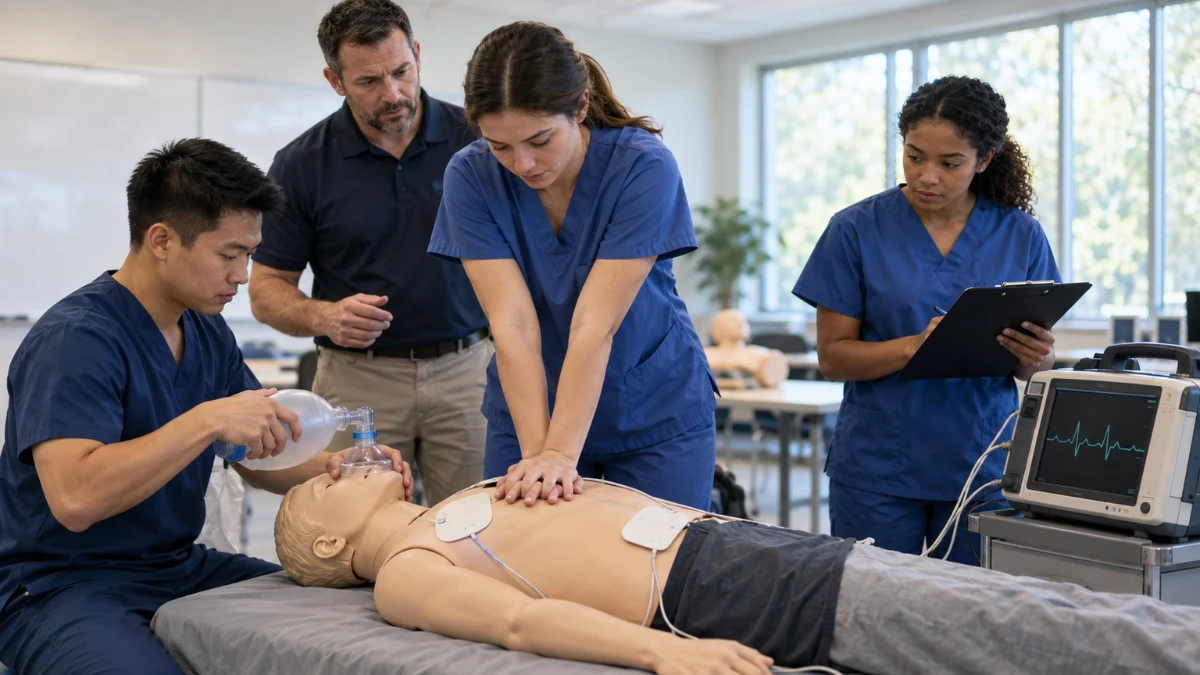
ACLS class time centers on hands-on practice in learning stations and simulated cardiovascular emergencies. The course follows the current AHA guidelines. It ends with a written exam and skills tests.
Topics Covered in ACLS Training
You review BLS and build advanced skills for real cardiac emergencies.
- BLS refresh: High-quality CPR and AED use.
- ECG rhythm recognition: Bradycardia, tachycardia, and arrest rhythms.
- Advanced airway: BVM, adjuncts, oxygen, and supraglottic options.
- Medication protocols: First-line drugs, doses, and sequences.
- Team communication: Roles, closed-loop communication, and leadership.
Written Exam and Skills Testing
- Written exam: Pass a multiple-choice test of your ACLS knowledge. The HeartCode online ACLS exam has 50 questions.
- Skills testing: Show your CPR and airway management skills. Then lead or support a team through a megacode scenario that tests your rhythm interpretation.
Your instructor debriefs you after each station. Each debrief shows where to improve before the next station.
Study Resources for the ACLS Certification Exam
The AHA ACLS Provider Manual is the core study text for the ACLS exam. The precourse self-assessment questions you miss point to the topics that need more review before class.
Recommended Materials
- AHA ACLS Provider Manual (digital or print).
- Rhythm flashcards to drill common strips (VF/pVT, asystole/PEA, brady/tachy).
- Mobile apps for algorithms, drug doses, and practice quizzes.
- Skills checklists from your Dallas training provider.
Online Practice and Guides
- Use the AHA’s ACLS course page and study tools.
- You may use your algorithm sheets and notes during the open-resource written exam.
Precourse Checklist
- Pass the AHA Precourse Self-Assessment and save your score report.
- Practice reading basic ECG strips before you drill the main arrest and peri-arrest rhythms.
- Know the indications and doses for core drugs like epinephrine, amiodarone, atropine, and adenosine.
- Practice team leadership by assigning roles, using closed-loop communication, and following algorithms out loud.
- Refresh BLS skills like compression rate and depth, minimal interruptions, and early defibrillation.
How to Verify Your ACLS Certification
To verify your ACLS certification, claim your eCard and share its code with your employer. The AHA eCard guide says claiming your eCard is the only way to show your employer proof of course completion. Your employer enters the code under the Employer tab to check the card’s status.
- Find the AHA email with your eCard claim link in your inbox, spam, or junk folder.
- Claim your eCard through the link in that email.
- View the claimed card on the AHA eCards Search page and download it in Full or Wallet size.
- Email the card to your employer or give them the eCard code to check.
After You Get ACLS Certified
Your AHA ACLS card stays valid for two years through the end of its issue month. Renew before it expires to keep your certification current. Our guide walks you through ACLS renewal in Dallas.
Next Steps in Your Healthcare Training
- BLS: Keep your CPR foundation current with our BLS renewal course.
- First aid: Build workplace and community response skills in Heartsaver First Aid CPR AED.
- PALS: Prepare for pediatric emergencies with our PALS Provider course.
- Instructor certification: Teach BLS or ACLS once you become an AHA instructor.
Get ACLS Certified in Dallas With EMR
Get the ACLS training you need at EMR Safety & Health. Our AHA Training Center has served Dallas healthcare professionals since 2002. You’ll get small classes and hands-on coaching from experienced AHA instructors.
New to ACLS? Choose our instructor-led classroom course. Prefer online learning? Complete HeartCode ACLS at your own pace, then attend an in-person skills check in Dallas.
View ACLS Courses and Register
FAQs About ACLS Certification
Find answers to common questions about getting ACLS certified.
How long does an ACLS certification last?
An ACLS certification lasts 2 years. AHA ACLS certification cards remain valid through the last day of the expiration month printed on the card. Renew before that month ends to keep your credentials valid. Renewal requires an approved ACLS course and passing skills assessments.
Can I get ACLS certified online?
No, you cannot earn an AHA ACLS card fully online. Every card requires a hands-on skills test. The blended HeartCode ACLS course puts the lessons and exam online. You then finish with an in-person skills session at an AHA Training Center like EMR Safety & Health.
What is the difference between BLS and ACLS?
The main difference between BLS and ACLS is the level of emergency medical care provided. Basic Life Support (BLS) includes CPR and automated external defibrillator (AED) use. Advanced Cardiovascular Life Support (ACLS) builds on BLS with advanced airway management, cardiac monitoring, medications, and cardiac resuscitation protocols.
Does ACLS include BLS?
No, ACLS does not include BLS certification. ACLS builds on BLS skills, but a current BLS provider card is not always required. Some training centers offer both certifications together.
Do I need BLS if I have ACLS?
Yes, you may need BLS certification even if you have ACLS certification. ACLS includes basic life support skills but does not provide a separate BLS certification. Some healthcare employers require both certifications. Check your employer’s requirements to determine whether you need both.
Is ACLS certification hard to get?
ACLS certification is moderately challenging but achievable with preparation. Healthcare professionals must understand cardiac rhythms, CPR, emergency medications, and cardiac arrest algorithms. The course requires passing a written exam and hands-on skills tests. Studying ACLS algorithms and practicing emergency response skills improves the likelihood of passing.
Is online ACLS certification accepted by employers?
Employers may accept an online ACLS certification card when it meets their training requirements. AHA ACLS certification requires a hands-on skills test during class or at a separate skills session. Fully online courses without practical assessments may not satisfy employer standards.