Determining a Confined Space

Man working in asn attic

A gas line near the alley was moved to clear a path for a larger driveway. The line was pressure tested and did not pass the test. Four leaks were found in the attic. The week before, workman were in the attic installing a vent-a-hood were exposed to the leaking gas. The good news is there was no hot work going to that could have been disastrous.

Confined Space

A confined space that contains certain hazardous conditions may be considered a permit-required confined space under the standard. Permit-required confined spaces can be immediately dangerous to workers’ lives if not properly identified, evaluated, tested and controlled. A permit-required confined space means a confined space that has one or more of the following characteristics:

    • Contains or has the potential to contain a hazardous atmosphere
    • Contains a material that has the potential for engulfing an entrant
    • Has an internal configuration such that an entrant could be trapped or asphyxiated by inwardly converging walls or by a floor which slopes downward and tapers to a smaller cross-section
    • Contains any other recognized serious safety or health hazard

Determining Confined Space or Permit Required

Before beginning work on a residential homebuilding project, each employer must ensure that a competent person identifies all confined spaces in which one or more employees work. They must also identify each space is a permit-required.

The competent person does not have to physically examine each attic, basement or crawl space, provided that the competent person can reliably determine whether the spaces with the same or similar configuration contain a hazard or potential hazard that would require the permit-space classification.

The initial evaluation may be done using existing experience and knowledge of the space by the competent person and does not need to be documented. A competent person responsible for inspecting new homes being built to identical specifications with the same materials need not physically inspect each attic separately to determine if it is a permit-required confined space.

How Spaces in Residences are Impacted

Spaces in a residential home may be considered confined spaces or permit-required confined spaces during the construction or remodeling process. The vast majority of the standard’s requirements only apply to permit-required confined spaces, and attics, basements, and crawl spaces in a residential home — three common spaces – will not necessarily trigger these requirements.

Attics

Attics will not be considered a confined space because there is not limited or restricted means for entry and exit unless there is a hazard. Access is the biggest determining factor for example, pull down stairs that resemble the structure of a stationary stairway and do not require an employee to ascend /descend hand-over-hand would not be considered a confined space if there are no impediments to egress. A scuttle hole would be limited access.

Attics that are determined to be confined spaces would generally not be permit-required confined spaces because they typically do not contain the types of hazards or potential hazards that make a confined space a permit-required confined space. But, has leaks, extreme heat in an attic can be considered a serious physical hazard such that the attic could be considered permit-required confined space.

Basements

Basements in a residential home that are designed for continuous occupancy by a homeowner are not considered confined spaces under the standard, provided the basement is configured as designed (e.g., has permanent stairs, a walk-out entry/exit, or an egress window installed).

Crawl Spaces

Crawl spaces in a residential home will not typically trigger the majority of the requirements of the standard unless they contain a physical hazard such as an exposed active electric wire.

Regardless of the area, the competent person needs to assess acute health hazards that may be present when assessing confined spaces, such as toxic (carbon monoxide), flammable, or explosive atmospheres. Safety Data Sheets (SDSs) must be maintained and reviewed to fully assess potential hazards prior to worker entry into a confined space to determine whether it is a permit-required space.

Employers Obligations

Host Employer

The employer who owns or manages the property where the construction work is taking place.

Controlling Contractor

The employer who has overall responsibility for construction at the worksite (note that if the controlling contractor owns or manages the property, then it is both a controlling employer and a host employer).

Entry Employer (Sub Contractor)

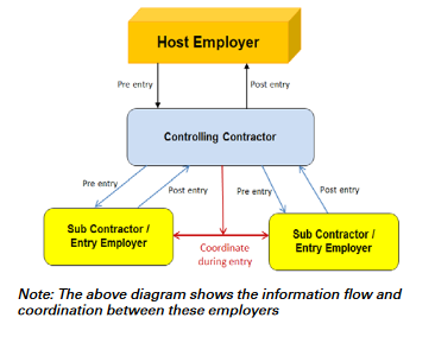
Any employer who decides that an employee it directs will enter a permit-required confined space. The standard makes the controlling contractor the primary point of

contact for information about permit-required confined spaces at the work site. The controlling contractor passes information it has about permit-required confined spaces at the work site on to the employers whose workers will enter the spaces (entry employers).

Entry Employer

Entry employers must give the controlling contractor information about their entry program and hazards they encounter in the space, and the controlling contractor passes that information on to other entry employers. The controlling contractor is also responsible for making sure that employers outside a space know not to create hazards in the space, and that workers from different entry employers working in a space at the same time do not create hazards for each other.

Host/Controlling Employer

Before entry operations begin, a host employer with the following information must provide it to the controlling contractor:

    • Location of each known permit-required confined space
    • Hazards or potential hazards in each space or the reason it is a permit-required confined space
    • Any precautions that the host employer or any previous controlling contractor/entry employer implemented for the protection of workers in the permit-required confined space
 

The multi-employer communication requirements only apply to host employers with employees who work at the worksite, regardless of when those workers are at the site and only apply to permit-required confined spaces. In addition, beyond this duties discussed above, host employers and controlling contractors are not responsible for compliance with the permit-required confined space program provisions of the standard if they have no reason to anticipate that the employees they direct will enter a permit-required confined space.

Entry Employer Obligations

Informing employees if they are working in the vicinity of each space of the location and danger posed by that space. This can be done by posting and positioning warning signs at each possible point of entry, or by other equally effective means.

The employer must also either take steps to prevent its employees from entering that space or ensure that entry only occurs through a permit program or as otherwise allowed by the standard (alternative entry procedures).

Employers must attempt to eliminate or isolate the hazards in the space. Engineering (ventilating) and work-practice controls (schedules, rotations) must be in place and finally, appropriate Personal Protective Equipment (PPE) is required if allowing an employee to enter a permit space.

Training on the space, the existence and location of, and dangers posed by, each permit-required confined space, and that they may not enter such spaces without authorization. Entry employers must train workers involved in permit-required confined space operations so that they can perform their duties safely and understand the hazards in permit spaces and the methods used to isolate, control or protect workers. Workers not authorized to perform entry rescues must be trained on the dangers of attempting such rescues.

The permit-required confined space program must establish a system for preparing, using, and canceling entry permits, which are written or printed documents that allow and control entry into permit spaces.

Entry employers must ensure that properly trained rescue and emergency services are available before entry into permit-required confined spaces. For a full discussion of an entry employer’s obligations to provide rescue, see OSHA’s Fact Sheet entitled: is 911 your Confined Space Rescue Plan.

Exposure to Bloodborne Pathogens

Blood borne Pathogens hazard sign

A bloodborne pathogen exposure incident is a specific eye, mouth, other mucous membrane, non-intact skin, or parenteral (needle stick or sharp object) contact with blood or other potentially infectious materials (OPIM), as defined in the standard that results from the performance of a worker’s duties.

OSHA’s Bloodborne Pathogens standard (29 CFR 1910.1030) requires employers to make immediate confidential medical evaluation and follow-up available for workers who have an exposure incident, such as a needle stick.

Reporting Exposures Requirements

Exposure incidents should be reported immediately to the employer since they can lead to infection with hepatitis B virus (HBV), hepatitis C virus (HCV), human immunodeficiency virus (HIV), or other bloodborne pathogens.

When a worker reports an exposure incident right away, the report permits the employer to arrange for immediate medical evaluation of the worker. Timely reporting is crucial for immediate intervention to address possible infection. It will also help the worker avoid spreading bloodborne infections to others.

The employer is required to perform timely evaluations of the circumstances surrounding the exposure incident to find ways of preventing such a situation from occurring again. Reporting is also important because part of the follow-up includes identifying the source individual, unless the employer can establish that identification is infeasible or prohibited by state or local law.  If the status of the source individual is not known, the employer is required to test the source’s blood as soon as feasible, provided the source individual consents. If the individual does not consent, the employer must establish that legally required consent cannot be obtained. If state or local law allows testing without the source individual’s consent, the employer must test the individual’s blood, if it is available. The results of these tests must be made available to the exposed worker and the worker must be informed of the laws and regulations about disclosing the source’s identity and infectious status.

Medical Evaluation and Follow-up

When a worker experiences an exposure incident the employer must make immediate confidential medical evaluation and follow-up available to the worker. This evaluation and follow-up must be: available at no cost to the worker and at a reasonable time and place; performed by or under the supervision of a licensed physician or other licensed healthcare professional. In addition, laboratory tests must be conducted by an accredited laboratory and also must be at no cost to the worker. A worker who participates in post-exposure evaluation and follow-up may consent to have his or her blood drawn for determination of a baseline infection status, but has the option to withhold consent for HIV testing at that time. In this instance, the employer must ensure that the worker’s blood sample is preserved for at least 90 days in case the worker changes his or her mind about HIV testing.

Post-exposure prophylaxis for HIV, HBV, and HCV, when medically indicated, must be offered to the exposed worker according to the current recommendations of the U.S. Public Health Service. The post-exposure follow-up must include counseling the worker about the possible implications of the exposure and his or her infection status, including the results and interpretation of all tests and how to protect personal contacts. The follow-up must also include evaluation of reported illnesses that may be related to the exposure.

Written Opinion

The employer must obtain and provide the worker with a copy of the evaluating healthcare professional’s written opinion within 15 days of completion of the evaluation. According to OSHA’s standard, the written opinion should only include: whether hepatitis B vaccination was recommended for the exposed worker; whether or not the worker received the vaccination, and that the healthcare provider informed the worker of the results of the evaluation and any medical conditions resulting from exposure to blood or OPIM which require further evaluation or treatment. Any findings other than these are not to be included in the written report.


Aerial Lift Safety Information

Aerial Lift 

Aerial lifts elevate your personnel, perform those hard to reach jobs. While they serve this great purpose and are generally safe, many workers are killed on aerial lifts each year.

Hazards of Aerial Lifts

The hazards associated with aerial lifts are numerous and lead to personal injury or death. An employee falling from an elevated level if the most thought of hazard. Anytime employees are exposed to a fall height greater than:

    • Four feet (4’) for General Industry
    • Six feet (6”) for Construction Industry

If you work at these height’s you are required to wear fall protection. Fall protection generally include: Body harness, six-foot lanyards, self-retracting lifelines and stress relief straps. The problem with six-foot lanyards in an Aerial Lifts is employees can climb the rails and work outside the safety of the rails. Four-foot (4’) lanyards are ideal for aerial lifts because they keep employees in the rails. Self-retracting lifelines are not ideal for Aerial Lifts because A four-foot lanyard which is anchored at the working surface (the floor) of the aerial lift will prevent employees from climbing the rails an exposing themselves to falls or orthostatic trauma.

Orthostatic trauma is harmful when employees are hanging for too long. Blood flow is restricted, building up toxins which can lead to clots, heart attacks or even death.

Other hazards include: objects falling from lifts, tip-overs, ejections from platforms, electric shock (electrocution), entanglement hazards, contact with objects such as ceilings, pipes and other objects.

Training Requirements

Most people think “how to operate” the Aerial Lift is the training task at hand, but so much more needs to be covered. Detailed explanations of electrical, fall, falling objects must be explained. Procedures and checklift6 are important to recognizing and avoiding unsafe conditions in the workplace. Understanding loads and capacities of the equipment including the importance of the manufacturer guidelines must be covered.

Training employees in recognizing unstable surfaces, holes, drop-offs or even loose dirt and rocks is required. Slopes, ditches, bumps, debris, and floor obstructions needs to be addressed. Strict attention to overhead obstructions, electric powerlines, and cables, as well as wind and weather conditions is required training.

Inspecting the work zone, taking corrective actions, setting outriggers, setting brakes and chocking wheels when necessary are items for training and action in addition to operating the lift is important to incorporate into Aerial Lift training.

Standards that apply to Aerial Lifts include:

    • 29 CFR 1910.67 and 269(p)
    • 29 CFR 1926.21, 453 and 502
    • ANSI/SIA A92.2-1969, A92.3, 92.5 and 92.6

Acclimate to Prevent Heat Illness

Woman with heat Illness

The risk of heat-related illness becomes greater as the weather gets hotter and more humid. Late Spring and early Summer when hot weather arrives early can be deadly because workers have not had a chance to adapt to warm weather. So, now is the time to climatize.

Your weatherman is beginning to talk of the “heat index.” Heat index is the is a single value that takes both temperature and humidity into account. The higher the heat index, the hotter the weather feels since sweat does not readily evaporate and cool the skin.

Heat Illness

OSHA does not have a specific standard that covers working in hot environments. Nonetheless, under the OSH Act, employers have a duty to protect workers from recognized serious hazards in the workplace, including heat-related hazards. Workers performing strenuous activity, workers using heavy or non-breathable protective clothing, and workers who are new to an outdoor job need additional precautions beyond those warranted by heat index alone. Due to the pandemic warnings, some are also required to wear face covering which also add to the heat.

Workers new to outdoor jobs or those with other illnesses and medications are generally most at risk for heat-related illnesses.

Time to Acclimate

That is why it is important to gradually increase the workload or allow more frequent breaks to help new workers and those returning to a job after time away build up a tolerance for hot conditions. Make sure that workers understand the risks and are “acclimatized”.

Steps to Take

  • Remind workers to drink water often (about 4 cups/hour)**
  • Review heat-related illness topics with workers: how to recognize heat-related illness, how to prevent it, and what to do if someone gets sick
  • Schedule frequent breaks in a cool, shaded area
  • Acclimatize workers
  • Set up buddy system/instruct supervisors to watch workers for signs of heat-related illness

Once the heat index gets too high, you must:

  • Alert workers of high-risk conditions
  • Actively encourage workers to drink plenty of water (about 4 cups/hour)**
  • Limit physical exertion (e.g. use mechanical lifts)
  • Have a knowledgeable person at the worksite who is well-informed about heat-related illness and able to determine appropriate work/rest schedules
  • Establish and enforce work/rest schedules
  • Adjust work activities (e.g., reschedule work, pace/rotate jobs)
  • Use cooling techniques
  • If possible, reschedule some activities to a time when the heat index is lower

It is best to move essential work tasks to the coolest part of the work shift and consider earlier start times, split shifts, or evening and night shifts.